BJJ for Kids
Here we answer some common questions about kids BJJ
Is BJJ safe for kids?
Yes - and here’s why:
No striking means there is less risk of impact injuries commonly associated with other martial arts.
You win by ‘submission’. We wait for the kids to be experienced positionally before introducing submissions and the concept of ‘tapping’.
Technique over strength. BJJ was developed for a smaller opponent to use leverage to gain control over a larger one. As a student of BJJ, your child would learn techniques and problem solving to handle a larger opponent. This is done through controlled games and drills
Academies should have 1 coach for every 10 under 16s, ensuring kids have appropriate supervision during the class.
Compared to other sports including football and gymnastics, the reported injury rate is much lower.
Coaching quality is important; all gyms should have appropriate safeguarding (see this article for more info), but the curriculum and the philosophy of the gym will impact your child’s experience.
However it should be noted that it is a martial art and accidents can happen.
Benefits of BJJ for kids
Confidence + self esteem: students experience adversity and overcome it in a supportive and fun environment. They will see progress, recognised with stripes and belts.
Self defence: BJJ teaches you to control a larger opponent calmly and without resorting to striking.
Builds resilience physically and mentally: learning how to remain calm in stressful situations when you are being physically dominated (but in a safe environment).
How to handle failure, which is an essential life skill
Fitness: games and sparring improves overall fitness and motor coordination.
Respect: Respecting the coaches, the other students, yourself and the mat is a large part of martial art philosophy.
Humility: There is always someone better than you in the room.
What age should kids start BJJ?
You can start as young as 3. The earlier years are essentially guided play to build physical coordination and get them familiar with the movement and positions of the sport. As they get older, classes adapt to suit their cognitive development, focusing increasingly on technique. The right time for your child really depends on their individual maturity.
At Myriad kids classes currently begin from age 5.
What can I expect for my child’s age group?
Ages 3-4: The goal here is for familiarity and confidence. There will be movement and cognitive games, mostly as a group (currently not available at Myriad, please email us at info@myriadjiujistu.com if you’re interested).
Ages 5-7: The goal here is fundamental movements and introduction to partner training. They will learn core positions, movements and concepts.
Ages 8-11: Introduction to specific techniques and constraint led games. They may learn some submissions in this age group.
Ages 12-15: Techniques become a larger part of their learning, and specific games are used to help the students develop their problem solving skillset. Appropriate submissions are taught.
At all ages, respect for team mates and the sport are encouraged. Whilst it is an individual sport, we are all working together to help one another get better.
Class Structure
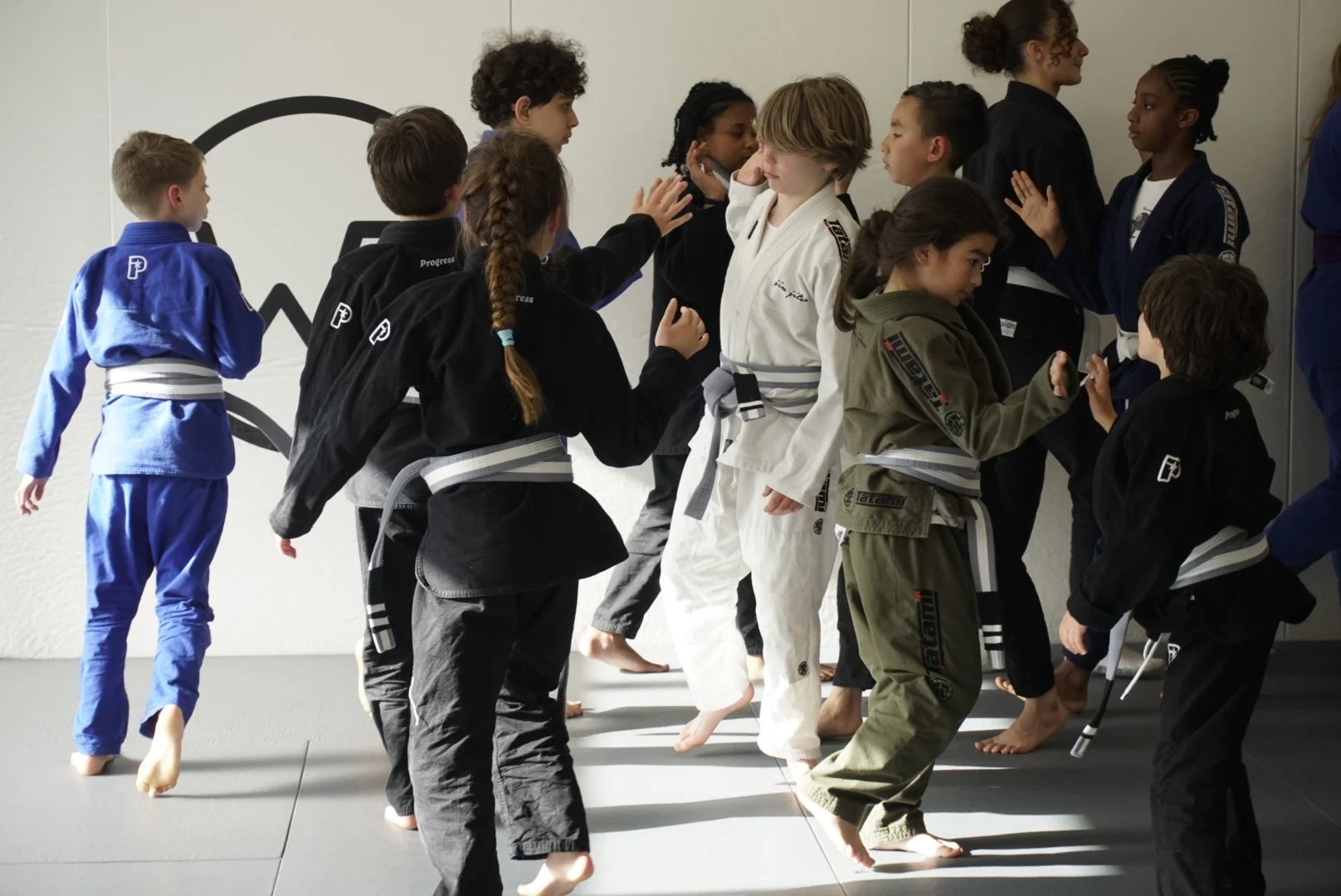
Our under 16 classes start with key movements to warm up. These are fundamental movements like forward rolls and hip escapes that they will use throughout their BJJ journey This is followed by partner games to get them grappling and exploring typical BJJ positions using play. Depending on the class, we usually end with a group game, or controlled sparring.
Belts and Stripes
We grade our under 16s twice a year. Kids are awarded new stripes and belts through three pillars: consistent training; skill development; respectful and considerate behaviour towards their piers and coaches, both on and off the mat.
Those under 16s who achieve these three pillars can progress faster through the belt system. New Belts are earned roughly once a year, and are carefully considered by the head coaches on an individual level.
There are over 60 possible promotions in the under 16’s belt system. Within each colour are three grades; white, solid and black.
White Belt: Where everyone starts. Understanding basic positions and movements, and learning to work with training partners.
Grey Belt: starting to work on intentional offensive strategies against resisting partners, i.e. to pin their partner to the mat; to sweep; to gain a positional advantage. Also to start to develop defensive strategies against attacking partners.
Yellow Belt: understanding how positions link together, and why they work. Beginning to build a greater awareness of the game.
Orange Belt: development of advanced understanding of BJJ, and starting to create unique strategies. This student is experienced, and will understand the concept of setting up positions and submissions.
Green Belt: this is the final belt in the under 16s system, and shows a youth who exhibits qualities of leadership and acts as a role model for others. They will have a well rounded game, and have demonstrated commitment and discipline in their training. Once this student turns 16 they will be eligible for an adult blue belt.
Our Coaches
All our coaches have a valid Emergency First Aid, Safeguard Training, Enhanced DBS and are insured through the BJJ governing body: UKBJJA.
How much does it cost?
Our priority at Myriad is high quality training and the safety of our students. For that reason we adhere to safeguarding standards of ensuring at least 1 coach for every 10 students under 16. Our membership prices reflect our efforts to make this the best training environment possible, and includes the bi-annual grading and new belts for our students. For our memberships please see here.
“Brilliant classes for children, very encouraging, inclusive and friendly. Beautiful space, with excellent facilities.”
“Myriad is a fantastic local club. Our family has experienced the teen classes. It’s well attended, coaches put on thoughtful training programmes, provide safe and very motivating environment to help young people progress. ”
“My two children aged 6 and 8 have been in little ones and juniors since September 2025. They absolutely love it.”
Curious?
Check out our membership options or book a free trial class.